
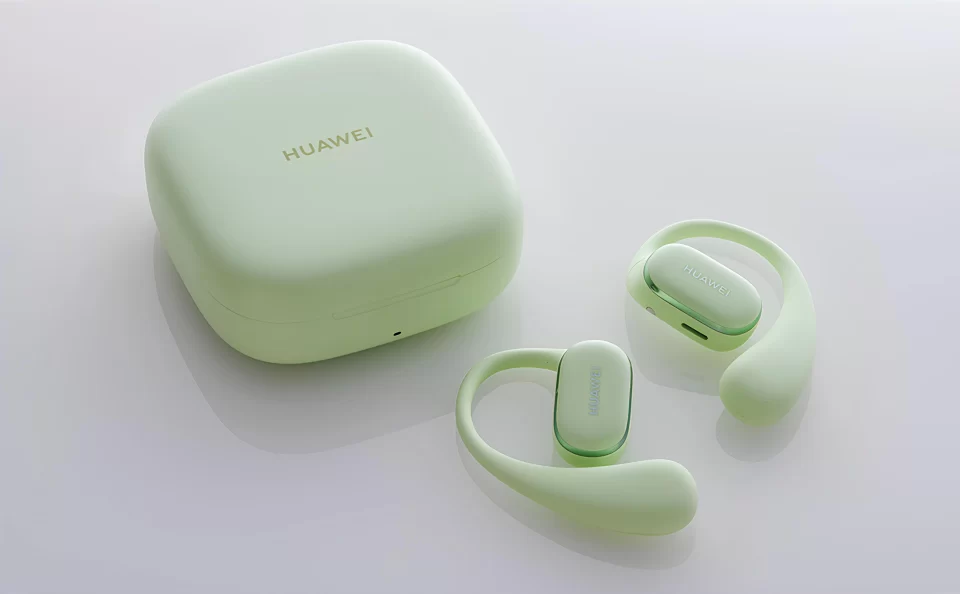
Offering competitive pricing, Huawei’s new set of open-ear headphones is a strong candidate for anyone into fitness. Although the headphones have their shortcomings, they manage to stay within the budget alongside providing decent performance.
Pros:
Remarkably comfortable with IP57 water and dust resistance Great situational awareness Competitive pricing
Cons:
Struggles in noisy environments Touch controls can be faulty in wet conditions Some audio leakage at high volumes
The Rise of Open-Ear Headphones
Huawei has stated that the market for open-ear headphones is booming, claiming sales growth of 600 % from the beginning of 2023 to mid-2024. While this percentage growth may be exacerbated by their relatively new presence in the market, it undoubtedly shows a shift towards the use of wireless earbuds that do not obstruct the ear canals.
Open ear designs classically come with trade-offs. These include little to no noise isolation as well as matching the audio fidelity of traditional in-ear designs. However, the pricing from Huawei makes the FreeArc appealing as a secondary headset for users who heavily rely on the use of noise canceling headphones but want something light and breathable for workouts.
How Much Am I Paying For What Exactly?
The Huawei FreeArc is set to retail at £100, but its currently available for pre-order at £75 ahead of the 3 March launch. £80 is the lowest threshold price until 1 April. This is a markable difference from the price of their previous open-ear device, the FreeClip, which was set at £170. This price range puts it up against rivals Shokz, JBL, and Bose.
For comparison, a four-star rated OpenFit by Shokz was offered at £179, but has since went down to £129. A candid recommendation was given to the JBL SoundGear Sense which was offerd at £130. Bose’s Open Earbuds Ultra come at the price of over 250 pounds.
Design & Build Quality
The FreeArc is offered in three colors, black, grey, and green, and specifically designed to be as light as possible, weighing at a mere 8.3g per ear bud. They have an IP57 rating, meaning they are protected against dust, and immersion up to 1 meter under water for 30 minutes. This makes them great for intense workouts and even rinsing off after use.
The earbuds fit over the ears perfectly. They do not budge even with vigorous movement. In my case, they did not move out of place when I was jogging, or even when I was doing HIIT or bodyweight workouts. They are far better than the competitors because they do not push against the ears, making them comfortable, and, best of all, forgettable after some time.
With the headphones, one may grant basic touch controls for answer and hangup, as well as for media playback. However, when it is necessary to perform these actions while the condition is wet, these commands may prove harder to fulfill. Still, they prove to be good enough to have clear voice communication, although strong winds may hinder this.
The battery life on these headphones holds at a charging time of seven hours. With the chunky charging case, it elevates to 28 hours, seeing as the case alone holds three extra charges. Unfortunately, wireless charging is not supported, but with such a large capacity, the case is able to allow the earbuds power throughout long sessions, charging them the whole time.
Strengths of the Free Arc
In short, The Free Arc brings together undisturbed comfort and functionality seamlessly. It is worth it since open-ear designed earbuds offering secure yet comfortable fit without discomfort gives optimised value for the cost increase.
Sound & Awareness Balance
Paying attention to surroundings while wearing open-ear headphones is helpful. The FreeArc headphones have been great to use with environmental sounds during runs and commutes. For example, the FreeArc headphones picked up traffic and cyclist noise during my commutes without hindering my ability to enjoy music.
Considering the open-ear profile and its features, the Free Arc headphones are decent. The vocals stay clear, treble is not harsh, and the bass is manageable enough to aid in workouts and exercise. The Free Arc is not created with audiophiles in mind, but it works perfectly for relaxed listening.
Water Resistance
The Free Arc headphones are moderately resistant to dust and sweat due to the IP57 rating, and can even withstand swimming to a certain extent, although Bluetooth signals do not function well underwater. People who are frequently in the rain or sweat a lot can benefit from the Free Arc headphones IP rating. The Jabra Elite 8 Active headphones are the only ones that outperform the Free Arc in IP rating.
Needed Enhancements
Despite the FreeArc’s multifaceted performance, some areas need improvement.
Difficulty Managing Background Noises
Due to the open ear design, the FreeArc lacks passive sound blocking and presents a challenge in louder environments. For example, at the gym, it was necessary to raise the volume beyond 80% just to overpower the background music. The same was true for public transport, where high volumes had to be used to avoid exceeding Apple’s audio exposure limit after extended use. This isn’t a fault of the FreeArc, but it is a downside of open ear headphones in general.
Sacrifices Made to Audio Performance
The FreeArc headphones, much like the Nothing Ear (a) in-ear buds, have substandard audio performance, but are better suited for workouts and exercise. Those looking for a an immersive experience and more pronounced audio detail may be disappointed with the FreeArc earbuds.
Wet Conditions Render Touch Controls Useless
Although responsive in dry conditions, touch controls became ineffective when the users sweated, or in this case, during heavy rain. Volume adjusting via swipe up and down gestures were sporadic at best and created additional problems while trying to use those gestures in the rain. For example, sometimes those actions would skip tracks instead of changing the volume, or activate Siri without the user intending to.
Limited Use of the App On iOS Devices
Currently, iOS users cannot access most features of the AI Life app, and can only view battery levels. Apple users are restricted, while Android users receive extra features, such as control customization and EQ presets, but need to sideload the app instead of download it from the Play Store like normal.
Possible Sound Leakage
Although leakage is negligible at moderate volumes, it becomes noticeable at higher levels. This makes them less suitable for quiet settings such as offices or public transport.
Should You Buy the Huawei Free Arc?
The FreeArc isn’t the most open-ear headphone on the market, but it gets the basics down spot on comfort, strength, and environmental care.
For a desperately needed gym-friendly, breathable alterative to traditional earbuds, the FreeArc is hard to beat. It’s cheaper than the Shokz OpenFit without losing too many of its crucial features. While some noise isolation and audio quality are given up due to the design, the FreeArc does well for itself.
At its launch price, the Free Arc is a decent choice for users who do a lot of exercising or are highly alert while using it. If you want the best audio fidelity or customization level, you will have to seek an alternative, but for what it was made for, Huawei has provided a very attractive offer.
